
BBAN stands for Basic Bank Account Number. It is the national account structure inside an IBAN, placed after the country code and check digits.
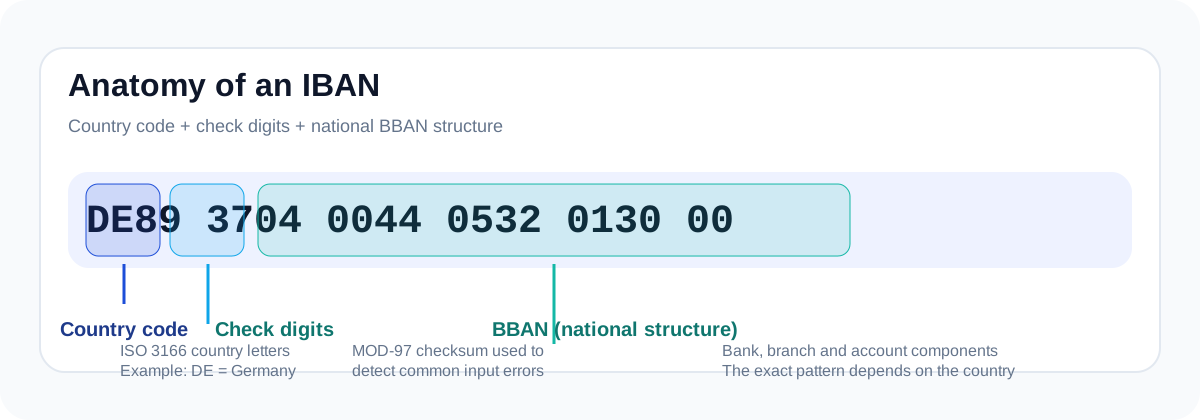
Depending on the country, the BBAN may include:
- Bank code
- Branch code
- Account number
- National check characters
When you validate an IBAN properly, you are really validating the country-specific BBAN pattern as well.
Read a BBAN without losing its context
In DE89 3704 0044 0532 0130 00, the first four characters are the international prefix and check digits. Everything after them is the BBAN: 370400440532013000. In this German layout, the first eight BBAN digits are the bank code 37040044 and the remaining ten are the account component 0532013000.
The leading zero belongs to the identifier. Store account components as text, not as integer values. Otherwise an export or spreadsheet can turn a ten-character value into a shorter one.
The national layout changes by country
| Country | BBAN layout | Practical consequence |
|---|---|---|
| Germany | 8-digit bank code + 10-digit account component | Do not drop account padding |
| United Kingdom | 4 bank letters + 6 sort-code digits + 8 account digits | A BBAN is not always numeric |
| France | 5 bank digits + 5 branch digits + 11 account characters + 2 RIB-key digits | The RIB key is a separate national check field |
| Netherlands | 4 bank letters + 10 account digits | Keep bank letters and account digits distinct |
These layouts explain why taking “the last eight digits” from any IBAN is unreliable. An account component can have another length, contain letters, or be followed by national check characters. Parse the country first, then apply that country’s layout.
BBAN, domestic number and IBAN are related
A domestic account number may be only one component of the BBAN. Bank and branch identifiers can be supplied separately in a local payment form. An IBAN brings the national structure together with a country prefix and international check digits.
Calculating an IBAN from domestic details also requires the correct national conversion rules. A simple concatenation can be wrong where a bank uses account padding, legacy account conversion or special bank-code rules. Use bank-confirmed details for real transfers.
What our tools verify
The local validator checks whether the BBAN characters match the registered pattern for the country. That pattern check is different from checking a domestic checksum or an active bank directory. The generator creates synthetic components that match the pattern and computes international check digits. It does not allocate an account or guarantee that every national banking rule is satisfied.
Sources and scope
Swift: national IBAN formats and registration authority.
Examples and test matrices are explanatory fixtures, not receiving instructions. This page covers format checks and software testing. It does not verify account ownership or provide a guarantee that a payment will succeed.
Technical notes updated 8 October 2026. Read the editorial policy. Send a correction.