
89 countries and territories use the IBAN system as of the SWIFT IBAN Registry Release 103 (September 2026). They span most of Europe, the Middle East, North Africa, parts of sub-Saharan Africa, Central Asia, and selected countries in the Americas: including Brazil. Each participant has its own official national format registered under ISO 13616.
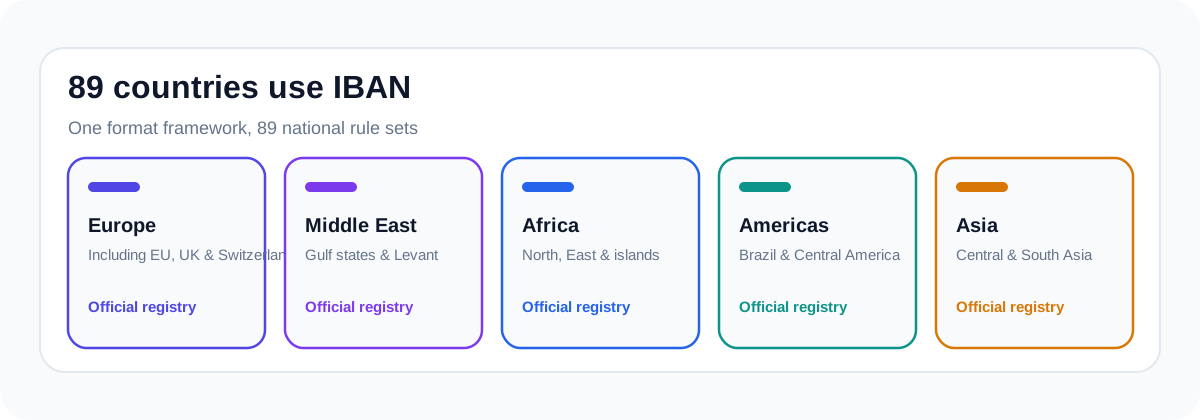
IBAN by region
- Europe: all EU members plus the UK, Switzerland, Norway, Iceland, the Balkans, Ukraine, Moldova, Belarus and: newly: the Russian Federation (33 characters, the longest IBAN).
- Middle East: Saudi Arabia, UAE, Qatar, Kuwait, Bahrain, Jordan, Lebanon, Israel, Iraq, Palestine, Turkey, plus newcomers Oman and Yemen.
- Africa: Egypt, Tunisia, Algeria-region coverage via Mauritania, Mauritius, Seychelles, plus new adopters Burundi, Djibouti, Libya, Sudan and Somalia.
- Americas: Brazil, Costa Rica, Dominican Republic, Guatemala, El Salvador, Saint Lucia, British Virgin Islands, plus new entries Honduras, Nicaragua and the Falkland Islands.
- Asia: Azerbaijan, Georgia, Kazakhstan, Timor-Leste, Pakistan, and Mongolia.
Big economies that do NOT use IBAN
The United States, Canada, Australia, Japan, China and India do not use IBAN. They rely on domestic systems: ABA routing + account numbers (US), NCC + BSB (Australia), Zengin codes (Japan). If you are paying into these countries you will be asked for the local identifiers, not an IBAN.
IBAN vs SEPA: not the same thing
IBAN is a format; SEPA is a payment scheme. All SEPA payments use IBAN, but many IBAN countries (Turkey, Brazil, Saudi Arabia…) are not in SEPA. Within SEPA you usually need only the IBAN; outside it you typically need the IBAN plus the bank's SWIFT/BIC code.
How to confirm a country's format
Never guess a format: check the exact length and BBAN structure in our IBAN format table (all 89 countries), or open a country-specific generator to see the structure with worked examples.
Separate three country lists
The countries with registered IBAN formats, the countries covered by this toolkit, and the countries supported by a payment provider are different lists. A tool recognizing a prefix does not mean your bank can send every kind of payment to that destination.
IBAN use is also different from SEPA participation. An IBAN can be used in a country outside the SEPA area. A country prefix alone cannot establish that a particular bank or account is reachable through a SEPA scheme.
How to use the country reference
- Read the first two letters of the bank-issued identifier.
- Find the corresponding national format and exact total length.
- Check whether the national component permits digits, letters or both.
- Use the payment provider’s supported destinations and receiving instructions for the actual transfer route.
Examples of different layouts
Germany uses 22 characters, France 27, Spain 24 and Norway 15. The UK national component starts with bank letters, while the German one is numeric. These differences explain why a single digits-only rule or one universal length cannot validate all IBANs.
What if there is no IBAN?
Ask the receiving bank for its international transfer instructions. The required details can include an account number and local routing code, a BIC, or intermediary-bank information. Do not construct an IBAN by attaching a country prefix to a domestic number.
Keep country coverage up to date
Swift publishes national IBAN formats as the registration authority. New formats or revisions require a data update in software using a bundled table. This website’s count describes its implemented dataset; it should not be interpreted as a universal current count for every validator or banking service.
For integration work, record the format dataset version alongside your fixtures. Treat a previously unsupported prefix as a data-maintenance question before deciding that a bank-issued identifier must be wrong.
Sources and scope
Swift: national IBAN formats and registration authority.
Examples and test matrices are explanatory fixtures, not receiving instructions. This page covers format checks and software testing. It does not verify account ownership or provide a guarantee that a payment will succeed.
Technical notes updated 8 October 2026. Read the editorial policy. Send a correction.